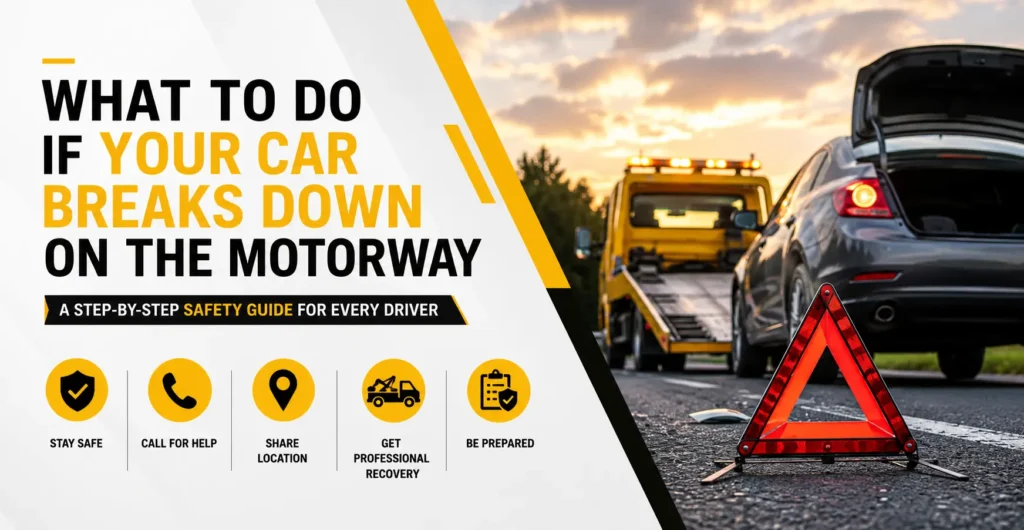
Breaking down on a motorway is a situation no driver wants to face. You may be travelling with your family, returning from another city, or driving to an important appointment when the car suddenly loses power.
On a motorway, you cannot simply pull over outside a nearby workshop and ask for help. Traffic is moving quickly, the next exit may be far away, and standing too close to passing vehicles can put you at risk.
Knowing what to do in those first few minutes can make a big difference.
Here is a practical guide for Pakistani drivers on what to do if your car breaks down on the motorway.
1. Stay Calm and Keep Control
When something goes wrong with your car, your first reaction may be to panic. Try not to.
If you notice the engine losing power, a warning light appearing, unusual noises, smoke, or a problem with the tyres, keep control of the steering wheel and gradually reduce your speed.
Check your mirrors before moving towards the emergency lane.
Do not suddenly brake or make a sharp turn. Other vehicles may be approaching at high speed.
Your first job is not to find out exactly what has gone wrong. Your first job is to get the vehicle and everyone inside it into the safest position possible.
2. Turn On Your Hazard Lights
Switch on your hazard lights as soon as you realize that your vehicle cannot continue normally.
This gives approaching drivers a warning that your car is in trouble.
Keep the hazard lights on while you are stopped.
They become even more important when:
- It is dark
- There is heavy rain
- Fog is reducing visibility
- Dust is affecting the road
- Traffic is moving quickly
A few extra seconds of warning can help another driver slow down and move around your vehicle safely.
3. Move to the Emergency Lane
If the car can still move, carefully take it towards the emergency lane or shoulder.
Do this gradually. Avoid sudden lane changes.
Once the vehicle is safely out of the main traffic flow, stop and keep the hazard lights active.
If the vehicle has completely lost power and cannot move, do not try to push it yourself.
Getting several people out of a car to push it beside fast-moving motorway traffic can create a much more dangerous situation.
4. Make Your Vehicle Visible
After stopping, make sure approaching drivers can see that your vehicle is stationary.
If you have a warning triangle, use it when it is safe to do so. A reflective vest can also make you more visible if you need to leave the vehicle.
Do not walk into traffic simply to place a warning device.
The warning equipment is useful, but your personal safety comes first.
At night or during poor weather, take extra care because approaching drivers may have less time to notice you.
5. Decide Whether to Leave the Vehicle
This is one area where drivers need to use common sense.
If your car is safely stopped on the shoulder and you can exit without stepping into traffic, moving away from the road can be a safer option.
Use the door on the side away from traffic and move towards a safer area. If there is a safety barrier, stay behind it.
Keep children and other passengers away from the road.
However, if getting out of the vehicle would place you directly beside fast-moving traffic, don’t take the risk.
Stay inside with your seat belt fastened and wait for assistance.
The safest choice depends on exactly where and how your vehicle has stopped.
6. Contact Motorway Police
If your vehicle has broken down on a motorway in Pakistan, Motorway Police can provide roadside safety support.
You can contact the Motorway Police Helpline at 130.
They can help with the immediate roadside situation and guide you when necessary.
For a mechanical breakdown, towing, or vehicle recovery, you may also need a professional recovery company with the equipment required to move your vehicle safely.
7. Share Your Exact Location
One of the most important things to do when requesting recovery assistance is to explain exactly where you are.
Simply saying:
“My car has broken down on M2.”
does not give the recovery team enough information.
Instead, provide:
- Motorway number
- Direction of travel
- Nearest interchange
- Kilometer marker
- Nearby sign
- Service area
- Bridge or landmark
If you have a smartphone, send your GPS location or a Google Maps pin.
Madadgar also recommends sharing a GPS pin, landmark, interchange, or kilometer marker when requesting motorway recovery, which can make it easier for the recovery team to locate you.
8. Call a Professional Recovery Service
Once you are in a safe position, contact a reliable recovery service.
The type of assistance required depends on the problem.
For a normal breakdown, Madadgar’s car towing service can be used when a vehicle cannot be driven safely and needs to be transported to a workshop, home, or another destination.
If the vehicle has suffered serious damage or has been involved in an accident, Madadgar’s car recovery service provides recovery for vehicles that are damaged, stuck, or unsafe to drive.
For a breakdown specifically on a motorway, you can also use Madadgar’s 24/7 motorway recovery service. The company lists coverage for major routes including M1, M2, M3, M4, M9 and M11.
9. Avoid Risky Repairs
You may think that a quick repair will get you moving again.
Sometimes it might.
But a motorway shoulder is not the same as a normal parking area.
If traffic is passing close to your vehicle, avoid repairs that require you to spend a long time outside the car.
Do not crawl underneath the vehicle.
Do not attempt complicated engine or electrical repairs.
Do not continue driving if you suspect a serious problem with the brakes, steering, engine, transmission, or wheels.
It is better to wait for professional assistance than to turn a breakdown into an accident.
10. What to Do During a Night Breakdown
A breakdown after sunset requires additional care.
Visibility is lower, and approaching vehicles may not notice a stationary car as quickly as they would during daylight.
Keep your hazard lights on.
Use reflective equipment if available.
Avoid standing between your vehicle and the traffic lane.
When calling for help, tell the recovery operator that you are stranded at night and provide your exact location.
If you have children or elderly passengers with you, mention this when requesting assistance.
11. What to Do During Rain or Fog
Bad weather can make a motorway breakdown even more difficult.
Heavy rain reduces visibility and increases stopping distances. Fog can make it difficult for approaching drivers to see a stationary vehicle.
During poor weather:
- Keep hazard lights on.
- Stay away from moving traffic.
- Avoid unnecessary movement around the vehicle.
- Do not cross the motorway.
- Share your GPS location with the recovery team.
- Wait in the safest available position.
If visibility becomes extremely poor, avoid attempting roadside repairs unless they can be completed without putting anyone at risk.
12. Common Reasons for Motorway Breakdowns
There are many reasons a vehicle may stop unexpectedly.
Engine Overheating
An overheating engine should not be ignored.
If the temperature gauge reaches the danger zone or steam comes from under the bonnet, stop safely and switch off the engine.
Never open a hot radiator cap because pressurized coolant can cause serious burns.
If the vehicle needs to be transported after an overheating problem, professional car towing can be a safer option than continuing to drive.
Flat or Burst Tyre
A damaged tyre can make the vehicle difficult or impossible to control.
Do not continue driving on a badly damaged tyre simply to reach the next exit.
If replacing the tyre is not safe where the vehicle has stopped, call for professional assistance.
Dead Battery
A weak or failed battery may leave you unable to restart the vehicle.
If the vehicle does not start after a safe attempt, professional roadside assistance may be required.
Fuel Shortage
Running out of fuel on a motorway can leave you stranded far from the nearest service station.
Check your fuel level before starting a long motorway journey.
Mechanical Failure
Engine, transmission, steering, suspension, or electrical problems can all make a vehicle unsafe to drive.
If you are unsure whether the car can continue safely, arrange professional recovery rather than taking the risk.
13. How to Prepare Before a Motorway Journey
A few checks before leaving can reduce the chances of an unexpected breakdown.
Before a long trip, check:
- Tyre pressure
- Tyre condition
- Engine oil
- Coolant
- Battery
- Brake condition
- Lights
- Fuel level
- Spare tyre
It is also useful to keep an emergency kit in your vehicle.
Useful Emergency Items
- Reflective warning triangle
- Flashlight
- Reflective vest
- First-aid kit
- Phone charger or power bank
- Basic toolkit
- Drinking water
- Spare tyre equipment
- Emergency contact numbers
Save a reliable recovery number in your phone before starting the journey.
It is much easier to make a call when you already have the number saved than to search for a recovery company while standing beside a broken-down car.
Frequently Asked Questions
1. What should I do first if my car breaks down on the motorway?
Turn on your hazard lights and, if the vehicle can still move safely, steer it towards the emergency lane or shoulder. Avoid sudden movements and focus on keeping yourself and your passengers away from moving traffic.
2. Should I get out of my car after a motorway breakdown?
If you can leave safely without stepping into traffic, move away from the road and use a safety barrier where available. If leaving the vehicle would expose you to immediate danger, remain inside with your seat belt fastened and wait for assistance.
3. Can I push my broken-down car to the side of the motorway?
It is not recommended. Pushing a vehicle beside fast-moving motorway traffic can put you and other people at serious risk. If the vehicle cannot move under its own power, call for professional assistance.
4. How can I tell the recovery company where I am?
Give the motorway number, direction of travel, nearest interchange, kilometer marker, road sign, or nearby landmark. Sharing your GPS location is one of the easiest ways to help the recovery team find you.
5. Can I change a flat tyre on the motorway?
Only attempt to change the tyre if your vehicle is in a genuinely safe position and you can work without being exposed to traffic. If the shoulder is narrow or traffic is passing close to you, contact a professional recovery service.
6. What should I do if my engine overheats on the motorway?
Move to a safe location, turn off the engine and allow it to cool. Do not open the radiator cap while the engine is hot. If the problem continues, arrange professional recovery rather than continuing your journey.
7. Does Madadgar provide motorway recovery 24/7?
Yes. Madadgar advertises 24/7 motorway recovery assistance and lists major motorway routes among its coverage areas.
8. Which motorways does Madadgar cover?
Madadgar currently lists M1, M2, M3, M4, M9 and M11 among its major motorway coverage areas.
Conclusion
A car breakdown on the motorway can be frightening, especially when traffic is moving quickly and you are far from the nearest city.
The most important thing is to avoid panic.
Turn on the hazard lights, move the vehicle towards the emergency lane if you can do so safely, keep yourself away from moving traffic, and share your exact location when requesting assistance.
Don’t try to push the vehicle or carry out risky repairs just to save a few minutes.
A professional recovery team has the equipment and experience to handle the vehicle safely.
Whether you are travelling on the M1, M2, M3, M4, M9 or M11, keeping an emergency recovery number saved can give you peace of mind before you start your journey.
Need Emergency Motorway Recovery?
If your car has broken down on the motorway, don’t put yourself at unnecessary risk.
Madadgar provides 24/7 towing and vehicle recovery assistance across Pakistan, including major motorway routes.
Contact Madadgar
Islamabad: 0334-5556667
Lahore: 0331-4443444
Rawalpindi: 0345-5556667
Peshawar: 0303-3337264
Karachi: 0331-6663666
Car broken down on the motorway? Contact Madadgar for professional towing and recovery assistance.